Blog · · 6min read
What a booking marketplace really costs: commission vs flat fee
A 25% or 30% cut of every new client sounds small until you multiply it by twelve months. The full maths for a salon with three professionals, including commission, per-staff fees and lock-in, and the one case where the marketplace does pay off.
“You only pay if we bring you clients.” That’s the line a booking marketplace is sold on, and it’s true. What it doesn’t say is how much you pay when they do bring them, for how long, or what happens to the monthly fee in the meantime. Let’s do that maths for a specific salon, because in the abstract 25% sounds small and in euros per year it sounds like something else.
The three ways they charge you
Everything a booking platform charges falls into one of these three:
- Commission per new client. A percentage of the first service of every client who arrives through the platform. Treatwell charges 25% of the first booking of each new client and 0% on the following ones. Booksy, through its Boost programme, charges 30% of the first visit of each new client.
- Flat fee. A monthly amount for using the tool, sometimes with an extra for each professional. Booksy costs €34.99 a month plus €8 a month for each additional staff member. Calendace costs €12.99 a month on the Standard plan and €34.99 on Premium, with no extra per professional within the plan’s limit.
- Lock-in and payments. Treatwell requires a 12-month minimum and charges 2% on every online payment. Booksy has no lock-in. Neither does Calendace.
The Booksy and Treatwell figures are the ones they publish at the time of writing; check their websites before signing anything, because they change.
The example salon
Take a salon with three professionals. Average first visit, €35 (a cut and simple colour, or a cut and beard with an extra). And say the marketplace brings 20 new clients a month, which is generous for a neighbourhood salon but good for seeing how the mechanism works.
Treatwell. 25% of €35 is €8.75 per new client. For 20 clients, €175 a month. With the 12-month lock-in, that’s €2,100 a year you’re committing to, plus 2% of everything your clients pay online, new and returning. Those clients’ repeat visits carry no commission, which is fair, but the figure above doesn’t go down as long as you keep receiving new clients.
Booksy with Boost. €34.99 fee plus two additional staff at €8: €50.99 a month, fixed. Boost adds 30% of €35, €10.50 per new client, €210 a month for the 20. Total: around €261 a month, around €3,130 a year. No lock-in, so you can switch Boost off whenever you like and stay on the €51 fee.
Calendace Standard. €12.99 a month, €155.88 a year. The plan covers three professionals, five services and 600 bookings a month. Paid yearly, €9.99 a month. No commission per client or per appointment.
Over a year, with the same 20 new people a month, the gap between the most expensive and the cheapest option on this list is around €3,000. For a three-chair salon, that’s more than a month’s rent in many cities.
What the maths doesn’t see
The calculation above has a catch, and it’s a catch in the marketplace’s favour: it assumes those 20 new clients wouldn’t have arrived any other way. If that’s true, €8.75 or €10.50 to win a client who might come back ten times is cheap. No Instagram ad gets you a client sitting in the chair for that price.
But there are three questions to ask before taking that for granted:
- What counts as a new client? Read the small print. If a client you’ve had for years books through the marketplace for the first time because they found you there, does that carry commission? If the answer is yes, you’re paying for clients who were already yours.
- Whose client is it? A client who finds you on a marketplace, books there, gets their notifications from there and has their history there is a client of the platform who comes to your salon. The day you leave, or the platform raises its prices, that client stays on the platform. And next to your salon, on the same list, are the other twenty in your neighbourhood.
- Can you leave? With a 12-month lock-in, not for a year. Without lock-in, yes, but the previous point still stands.
When the marketplace does pay off
There’s one clear case: the new business with no clientele. You’ve just opened, nobody knows you, and every person who walks through the door is worth gold. At that point, paying 25% or 30% of the first visit in exchange for appearing where people are searching is a good investment. You have no client list to protect, and what you need is a full calendar as soon as possible.
And it stops paying off when what happens to almost every salon that works happens: after a year or two, most appointments are from clients who repeat. They come through word of mouth, Google, Instagram or the QR code on your counter. At that point the marketplace keeps charging you per staff member and commission on every new person who might have arrived anyway, and in return gives you a visibility you no longer need as much.
The sensible strategy
You don’t have to choose for good. What we see working:
- When you open, the marketplace if your area uses it, and your own booking page from day one so that clients who come by recommendation or through Google book without commission. Be careful about signing long lock-ins at this stage: you don’t yet know how things will go.
- When the calendar fills up, get every returning client booking on your own page: the link on Instagram, the QR at reception, the reminder with the link to book again. The marketplace becomes one more source of new clients, not the place where your calendar lives.
- When the marketplace brings in less than it costs, switch it off. To know, every quarter count how many new clients came through it and multiply by the commission. If that figure plus the fee is more than you earn from those clients, you have your answer.
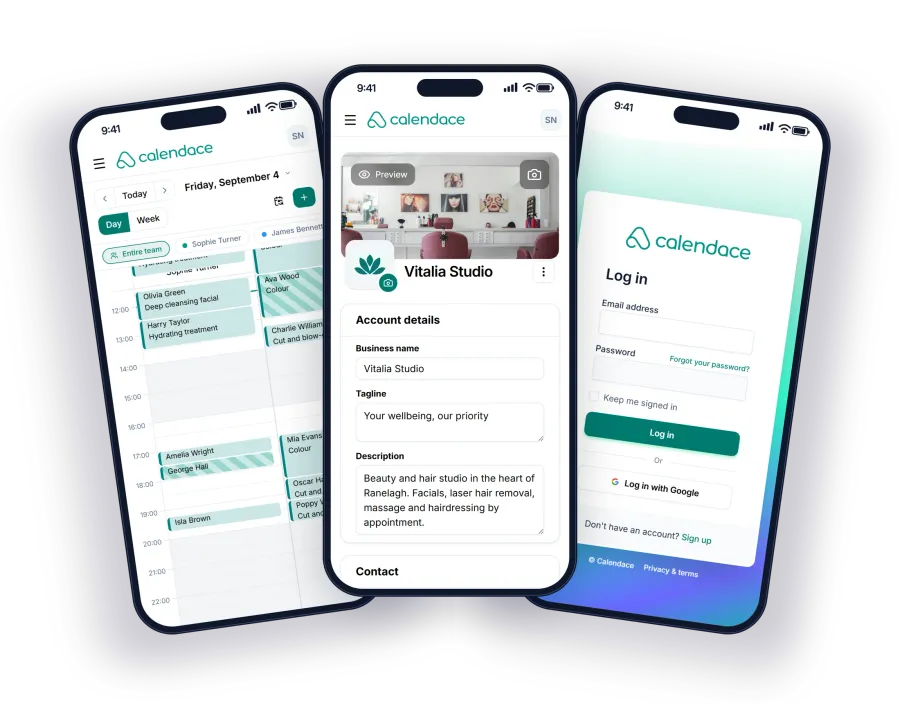
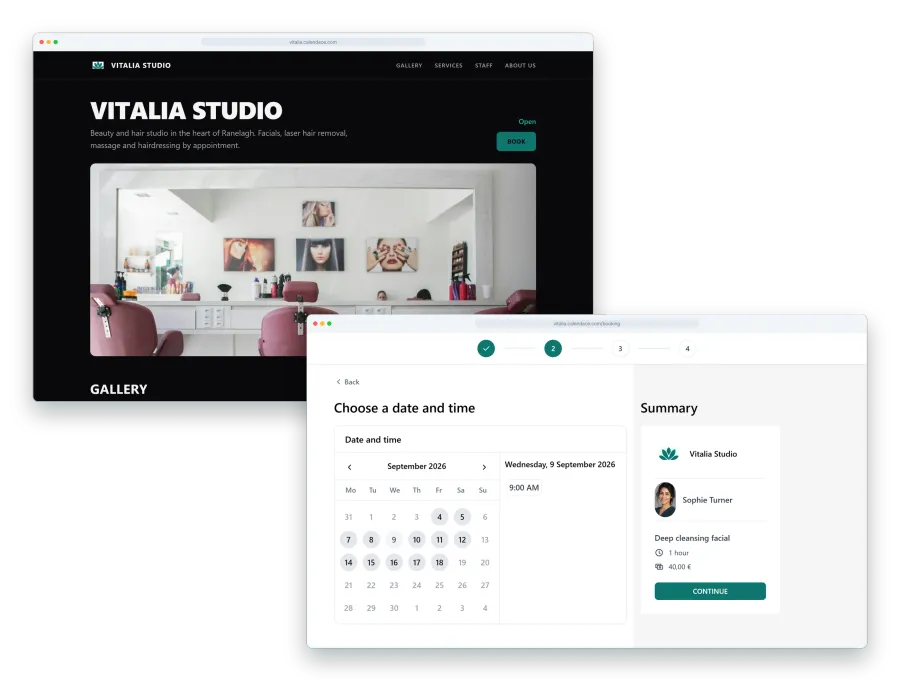
Calendace is built for the second and third phases: it isn’t a marketplace and doesn’t bring you new clients, so it doesn’t charge you for them either. It’s your booking page, with your name, your client list and a flat fee you can see on pricing. We explain the model under no commission, and if you’re comparing against a specific platform, we have comparisons with Booksy and with Treatwell.
The maths you should do yourself
Take last month’s calendar and split the appointments in two: clients who had been before and new clients. Then look at how many of the new ones came through a platform and how many through recommendation, Google or social media.
If new clients are under 20% of your appointments and half of them don’t come from the marketplace, you’re paying commission and per-staff fees for a small fraction of your business. If new clients are half your appointments and nearly all come from the marketplace, the marketplace is holding you up and the commission is its fair price. Neither situation is bad. What’s bad is not knowing which one you’re in.
And for the yearly numbers, there is the commission calculator: enter how many professionals you are, the price of a first visit and the new clients per month, and it shows what you would pay with each option.