
Blog · · 5min read
Five numbers your salon should check every week (and what to do with each one)
Appointments served, revenue per appointment, no-shows, empty slots and returning clients. How to read each one, which decision to take, and a five-line sheet for Monday morning.
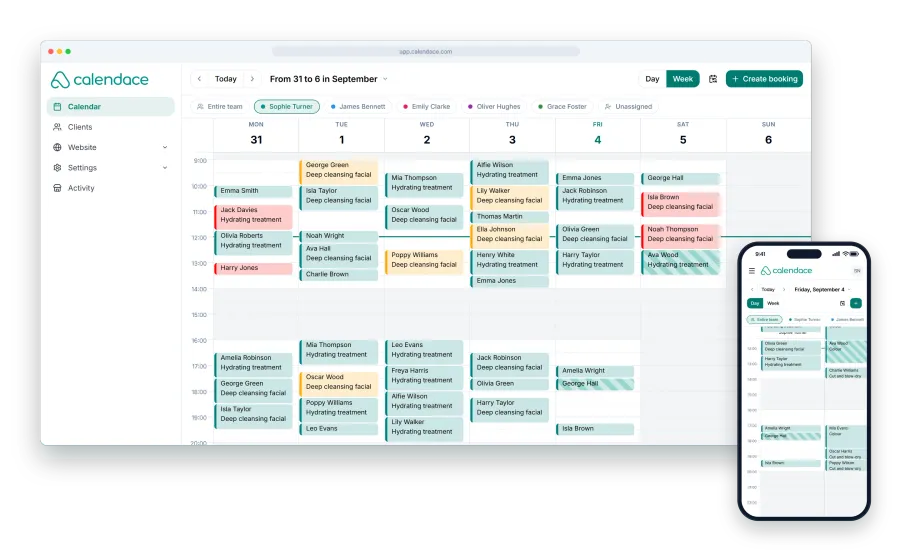
The calendar is full, the till more or less adds up and the month ends the way it ends. That’s the accounting in most small salons, and it works until one month ends worse and you don’t know why. Did fewer clients come? Did the same ones come and spend less? Did more of them not turn up? Or was every other Tuesday half empty?
Without numbers you don’t know. And you don’t need many. Five, once a week, Monday morning with a coffee, is enough to see almost any problem a month before it shows.
1. Appointments served
How many appointments happened last week, minus the no-shows and the cancellations. Not the ones booked: the ones that were done.
How to read it. The number on its own says nothing; the comparison does. Write it down every week and look at four in a row. Say 92, 95, 88, 90: stable. 92, 85, 80, 74: something is happening, and you’re seeing it three weeks before it shows in the month’s takings.
What to decide. If it’s dropping and it isn’t seasonal, look at the other four numbers before touching anything. One of them almost always tells you why.
2. Revenue per appointment
The week’s revenue divided by appointments served. This is the number that separates “fewer people are coming” from “the same people are coming and spending less”.
How to read it. If you have 90 appointments and €2,250, that’s €25 per appointment. If the following week it’s 90 appointments and €2,070, it’s €23. The appointments haven’t changed; what’s changed is which services are being booked. Less colour, more plain cuts. Fewer treatments, more basic manicures.
What to decide. This is the cheapest lever in the salon. It isn’t raising prices: it’s offering the add-on service at the till. If one in five people who come for a cut adds a €10 treatment, across 90 appointments that’s €180 more a week without a single new client.
3. No-shows
Booked appointments where the client neither came nor let you know. As a number and as a percentage of bookings.
How to read it. A salon with a day-before reminder is usually under 5%. If you’re at 10% or more, the problem isn’t the clients: it’s that the reminder isn’t arriving, arrives too late or doesn’t exist. We cover which channel to use in WhatsApp vs SMS for appointment reminders.
Look at who isn’t turning up, too. If the no-shows are different people every week, it’s a reminder problem. If it’s the same three people, it’s a problem with those three people. In Calendace, each client’s record counts how many times they didn’t show, so you don’t have to keep that part in your head.
What to decide. Reminder switched on, if it isn’t. A clear, visible cancellation window. And for anyone who racks up three no-shows, a phone call, and if it continues, a block. It’s cheaper to lose that client than to lose their slot every month.
4. Empty slots
Hours in the calendar that were open and had nobody in them. Counted per professional and per band: Monday 10 to 12, Tuesday 4 to 6.
How to read it. This number has a shape. It’s almost never spread evenly: it concentrates in two or three bands that repeat every week. Add up the empty hours and multiply by what a booked hour brings in, and you have the cost. Say 12 empty hours at €30 an hour: €360 a week the salon was open and nothing came in.
What to decide. Two options, and neither is cutting the price. One: fill the band by moving your returning clients into it, which is easier than it sounds and we cover in how to fill a barbershop’s slow days. Two: if a band has been empty for two months whatever you do, close it and save the hour of work. A well-placed split schedule is worth more than a morning open for nobody.
5. Returning clients
Of the week’s appointments, how many were from someone who had been before. As a percentage.
How to read it. This is the slowest number and the most important. An established salon lives on repeat visits: if 70 or 80% of appointments are from returning clients, the business has a base. If it drops below 50%, you depend on new people walking in every week, and that’s expensive and exhausting.
Watch the rhythm too. A cut client comes every four weeks; a colour client every six or eight. If the four-weekers start coming every six, appointments served fall even though you haven’t lost anyone.
What to decide. The most direct way to raise the repeat rate is to give the next appointment before the client walks out the door. “Shall I put you down for four weeks from now?” That also means next month’s slot is already taken. If they’d rather do it themselves, let it be from your page, through the link in the reminder or from their client area.
Where the numbers come from
All five come out of the calendar, and with a notebook and fifteen minutes on a Monday you can work them out by hand: appointments, revenue, no-shows, gaps, returners. It’s what any salon did twenty years ago, and it still holds.
If you use Calendace, appointments and revenue by day, week, month or year are in the statistics, which come with the Premium plan. Each client’s no-shows are in their record on the Standard and Premium plans. You don’t need Premium to do this; you need to do it every week. The plans are on the pricing page.
The Monday sheet
A template that fits in a note on your phone:
- Appointments served: ___ (previous week: ___)
- Revenue per appointment: €___
- No-shows: ___ (___%)
- Empty hours: ___ (bands: ___)
- Appointments from returning clients: ___%
Five lines, four weeks in a row, and you’ll know more about your salon than you do now from looking at the till. The week’s decision is usually a single one: the number that moved the most is the one to act on.
