
Blog · · 6min read
Client records: what to note down so they come back
The colour formula, the nickel allergy, that they'd rather not chat, that they prefer Lucy. What you write on the record is what makes a client feel remembered. What to note, who should see it, and why the list has to be yours.
A client walks into your salon for the second time. The first time you did a colour she loved. Today a colleague is looking after her and asks what she had done. The client can’t remember (“a brown, sort of mahogany, I think”) and your colleague does her best. It comes out fine, but not the same. The client doesn’t complain. She simply tries somewhere else next time.
That’s what not having a record costs. It’s not an angry client, it’s a client who doesn’t come back and you don’t know why. And what prevents it is cheap: thirty seconds at the end of each appointment to write down what you did and what you learned about that person.
What the record already knows on its own
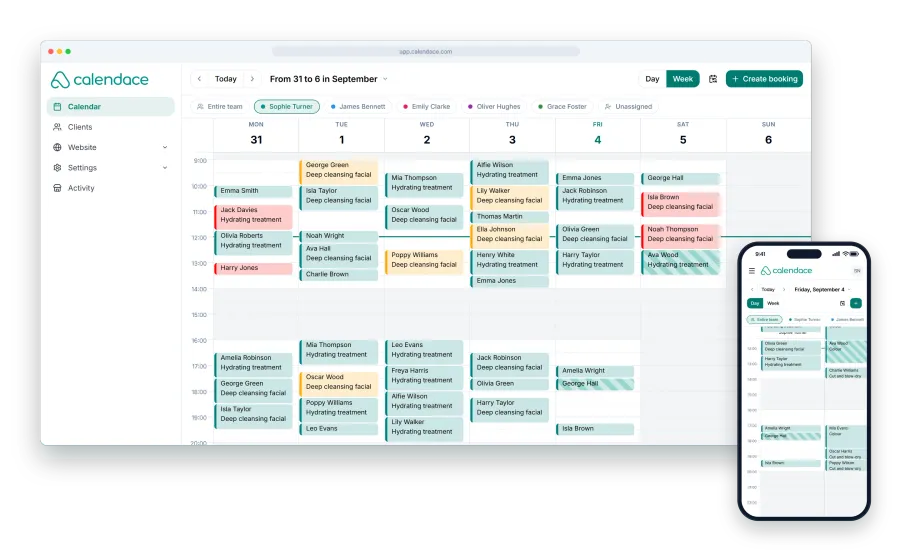
Before talking about what to write, it helps to know what you don’t need to write. In Calendace, every client who books has a record that fills itself in from what happens in the calendar: the appointment history (which service, with whom, on what day), how many times they didn’t show up, and whether they’re blocked from booking online. That already answers “when did they last come” and “how often do they come” without anyone typing a word.
What it can’t know on its own is what happens during the service. That’s what private notes are for, a free-text field on the record that only your business sees, never the client. And that’s where the difference lies between a salon that remembers and one that doesn’t.
What to note: five things
You don’t need a long form. Five kinds of note cover almost everything, and each fits on one line.
1. The formula or the technical detail. In hairdressing, the exact colour: brand, shades and proportions, developer volume, processing time. In a barbershop, the clipper guard and how they like the neckline. In beauty, the laser intensity or the product used. In physiotherapy, the area and the technique. It’s the note that makes the service come out the same even when someone else does it.
2. Allergies and contraindications. Reaction to ammonia, nickel allergy, skin sensitive to wax, pregnancy, medication that affects a treatment. This note goes first of all, in capitals if need be, because it’s the only one that can prevent a serious problem.
3. What they like and what they don’t. “Likes to chat”, “prefers quiet and a magazine”, “doesn’t want the dryer too hot”, “always has a latte”. It sounds trivial, and it’s what gets noticed most. A client who’s offered their usual without being asked feels at home.
4. Who they prefer. Whether they always book with the same person, or whether they once came out of someone else’s chair and never repeated. When they book “first available” on your page and then ask to switch, the note explains it.
5. How often they come, and what they were told. The history already gives the dates, but the note adds context: “every 5 weeks, cut and beard”, “colour every 6, recommended a treatment and said she’d think about it”. It’s what lets you message them meaningfully when they’ve been away two months.
An example of a complete record, in four lines:
NICKEL ALLERGY. Colour 6.35 + 6.0 (1:1), 20 vol, 35 min. Prefers Lucy, doesn’t like the ends cut much. Comes every 6 weeks; last time I mentioned the keratin treatment.
Who should see it (and who shouldn’t)
The simple rule: whoever serves the client sees it; the client doesn’t.
Calendace private notes never appear on the booking page or in the client area. The client sees their appointments, their history and their details, but not what you’ve written about them. That lets you write naturally (“wasn’t happy with the March highlights, go carefully”) without it turning into a problem.
Within the business, anyone who works in the dashboard can check the record before serving. That’s what you want: the colleague covering for Lucy opens the record, sees the formula and the allergy, and does the same job. A salon where the information lives in one person’s head has a problem every time that person has a day off.
And one rule for what gets written: nothing you wouldn’t want the client to read if they asked for it one day. The note describes the service and the preferences, not the person.
When to write it
The only way the record stays up to date is writing it in the moment. When the service ends, before taking payment or right after, while the client puts their coat on. If you leave it for the end of the day, it doesn’t get written.
Two habits that help:
- Open the record when the appointment starts. Even if you think you remember. It’s the moment to see the allergy and the formula, and to say “same as last time?” knowing exactly what last time was.
- One line when you finish. Only what’s changed: a new formula, something they said, something you recommended. No need to rewrite the whole record.
Why the list has to be yours
There’s one last point that isn’t about what you write, but about where it’s written. A salon’s client list, with its history and its notes, is probably the most valuable asset the business has. More than the premises, which are rented.
And yet it’s very common to keep it somewhere it can’t be taken out of. In a notebook that gets wet. In an app that doesn’t export. On a marketplace where the client, in practice, belongs to the platform, and if you leave, the list stays.
Two questions to ask any tool you put your clients into:
- Can I get the full list out, with notes and history, whenever I want? If the answer is “write to support” or “no”, it isn’t your list.
- Can I take it with me if I stop paying? No lock-in, and no data vanishing when you cancel.
In Calendace, client export is on the Premium plan, and there’s no lock-in on any plan. The record with history and notes is there from the Standard plan. You can see the details on the pricing page and what the record includes under features.
What changes when the record is done right
Back to the client from the start. Second visit, a different colleague. She opens the record: nickel allergy, the colour formula, prefers Lucy, doesn’t like the ends cut much. She says “I’ll do the same mahogany brown as last time, did you like it?” and asks whether she’d rather wait for Lucy next time or is happy with her. The client feels remembered. She comes back.
Multiply that by the 200 or 300 clients who pass through a small salon in a quarter. It’s the difference between a business that depends on finding new people all the time and one that lives off the ones it already has. And since you have it anyway, the record also serves the opposite purpose: knowing who doesn’t show up and deciding what to do about them with data, not with hunches.
