Blog · · 6min read
Salon cancellation policy: 12, 24 or 48 hours, and what to do when someone breaks it
How to choose the cancellation window for a salon without scaring anyone off, how to communicate it so it sticks, what to do with late cancellers, and why a waitlist lets you run a shorter window.

A salon’s cancellation window is usually born out of frustration. Someone cancels twice in a row with an hour’s notice, and by the third time there’s a sign at the front desk: “appointments must be cancelled 48 hours in advance”. It’s understandable, but a window set like that almost never gets respected, and sometimes it costs more clients than it protects.
Setting it well is a calculation, not a rule. It’s about how long you really need to fill a slot, and how much you are willing to inconvenience the clients who do give notice.
The window is how long it takes you to fill a slot
That’s the only question that matters. If someone cancels and you have a way to cover that slot within two hours, you don’t need 48 hours of notice; 12 is plenty. If your only way to cover it is a walk-in or ringing people one by one, you need every bit of margin you can get.
Three reference points:
- 12 hours. Barbershops and salons with lots of walk-ins, short services (cut, beard, trim) and a calendar that moves a lot. A 30-minute slot almost always fills itself. A long window here annoys people without giving you anything back.
- 24 hours. The default for most hair and beauty salons. It gives time for a free-slot alert to arrive, be read and be booked. It’s what clients expect by default and the one that needs the least explaining.
- 48 hours. For long, expensive services, where the lost slot is two or three hours of a professional’s day: full colour, straightening, extensions, long tattoo sessions. Here the slot is hard to refill because you need another client who wants exactly that service and has exactly that afternoon free.
If in doubt, start at 24. It’s easier to shorten later than to lengthen.
A window you can’t enforce is worse than none
Calendace doesn’t handle payments, deposits or card penalties, and in a small salon we think that’s an advantage. A deposit scares off a share of new clients before they’ve met you, and charging a penalty to someone who has been coming for years is the quickest way to lose them.
But it means your window rests on two things: that it’s easy to comply with, and that you keep track of who doesn’t. Without a deposit, a 48-hour window nobody can comfortably meet is just a sign on the wall.
How to communicate it so it sticks
Three places, and the same number in all three.
On the booking page. Before they confirm, not after. One line: “You can cancel or change your appointment up to 24 hours before from the link we’ll send you”. It’s information, not a threat.
In the confirmation. The same text, with the link already in it. That’s the message the client keeps.
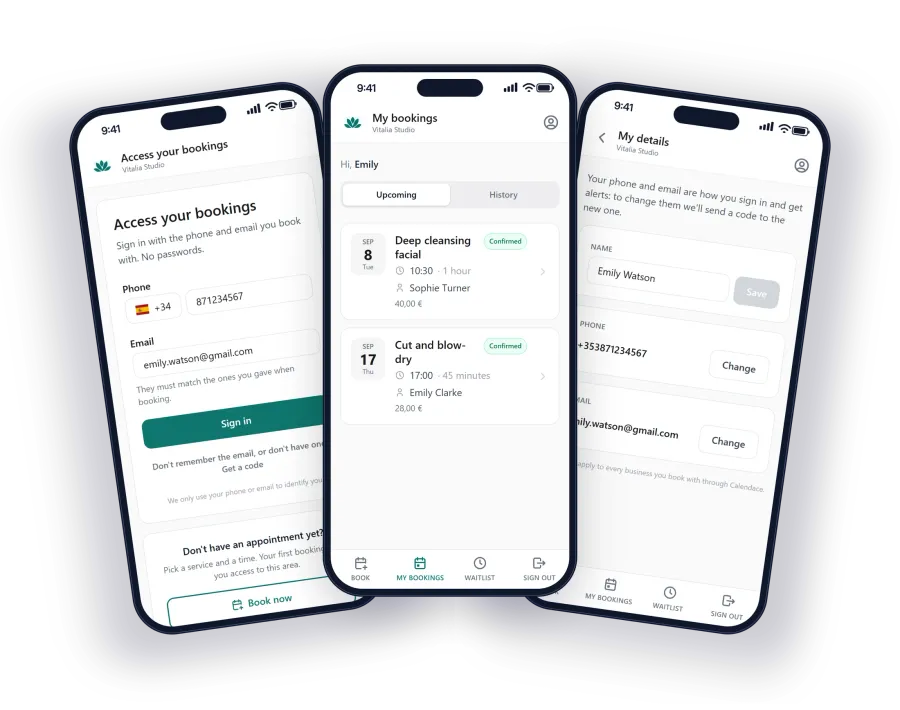
In the reminder, and before the window closes. This is where most salons slip. If your window is 24 hours and the reminder goes out 24 hours before, it lands at the exact moment the client can no longer cancel. Send the reminder with more lead time than the window: at 48 hours if your window is 24, at 24 if it’s 12. In Calendace the reminder lead time is set separately from the cancellation window, and the link in the notification only allows cancelling while the window is still open. There are reminder templates in another article.
What you don’t need: the threatening sign, the paragraph in capitals, the list of exceptions. The shorter it is, the more it gets read and the less argument it creates.
What to do when someone cancels late
It will happen. The question is what you do about it, and the answer depends on how many times.
The first time, nothing. People get ill, their kids get ill, their car breaks down. A “thanks for letting us know, let’s find another day” costs nothing and keeps a client. Note it on their record, with the date. In Calendace the client record has private notes and counts how many times they didn’t show up.
The second time, you tell them. No drama: “Next time, please give us a day’s notice, because otherwise the slot stays empty”. Most people have no idea what a late cancellation does to a small salon, and telling them once is enough.
From the third time, you change the terms for that person. Not for everyone. Options that don’t involve charging anything: turn on manual approval, so their bookings arrive as pending and you decide; give them slots only in stretches you don’t mind losing; or, if it’s no longer worth it, block them so they can’t book through the page. With three or four clients flagged like this on their records, the late-cancellation problem usually halves, because it’s almost always the same people.
What doesn’t work is tightening the rule for everyone because of those four.
How a waitlist changes the maths
Everything above assumes a slot cancelled late is lost. With a waitlist that sends alerts on its own, that’s no longer entirely true.
Take a salon with a 24-hour window and two late cancellations a day at €25. Without a waitlist, that’s €50 a day lost, €1,200 a month. With a waitlist, each freed slot triggers an alert to the first three people waiting for that day and that shift; if nobody books within 30 minutes, it moves to the next three. If that covers one slot in three, the damage drops to around €800 a month, and it does so without you ringing anyone.
And it changes the window. If a slot freed at ten in the morning has a real chance of being covered before twelve, a 12-hour window starts to make sense where you used to need 24. Put another way: the better you cover slots, the less you have to demand from the clients who do give notice. We explain how the waitlist works with cancellations in more detail.
A rule to take away
Set the shortest window you can honour with the way you fill slots. Say it in three places with the same number. Send the reminder before it closes. Keep track per client instead of punishing everyone. And if half the problem is four names, treat it as what it is: a problem of four names.